Home Interests Mac

How to Display macOS Notifications from the Command Line

howchoo
howchoo   (467)
November 24, 2023
3 minutes

Share

Interests
Posted in these interests:
 
apple • 18 guides

Mac

mac • 24 guides

In this guide, we’re going to use AppleScript and a tool called osascript to display macOS notifications. AppleScript is a scripting language created by Apple that allows us to automate control of Mac applications, and osascript is a tool that allows us to execute AppleScript from the command line.

With these tools, we can easily display macOS notifications from the command line or from within shell scripts.

1 – Use the “display” AppleScript command

Text-only notification

The display command can be run like this:

display notification "test notification!"

But if we want to execute this from the command line, we need to use osascript with the -e flag.

osascript -e 'display notification "test notification!"'

Notification with a title

osascript -e 'display notification "test notification!" with title "This is the title"'

Run any of these examples from the Terminal application (or your favorite terminal emulator), and you’ll see the notifications appear!

NEXT UP

How to Enable the “Popping” Sound When Adjusting the Volume on Your Mac

howchoo

howchoo   (467)
December 13, 2023

Starting with MacOS Sierra and High Sierra, your Mac will no longer play a “pop” sound when you adjust your volume. If you prefer to have this sound when you adjust volume up and down (as I do), this guide will teach you how to reenable it. 1 – Open Sound System Preferences Navigate to System

Continue Reading

howchoo

 467 guides

Introducing Howchoo, an enigmatic author whose unique pen name reflects their boundless curiosity and limitless creativity. Mysterious and multifaceted, Howchoo has emerged as a captivating storyteller, leaving readers mesmerized by the uncharted realms they craft with their words. With an insatiable appetite for knowledge and a love for exploration, Howchoo’s writing transcends conventional genres, blurring the lines between fantasy, science fiction, and the surreal. Their narratives are a kaleidoscope of ideas, weaving together intricate plots, unforgettable characters, and thought-provoking themes that challenge the boundaries of imagination.

Home Interests Synology

How to Set Up Quick Connect on a Synology NAS

Get Synology’s powerful Quickconnect running in minutes on your NAS!
howchoo   (467)
November 24, 2023
6 minutes

Share

Interests
Posted in these interests:
cloud • 2 guides

NAS

nas • 2 guides
synology • 2 guides
technology • 20 guides

Synology is one of the most popular creators of Network Attached Storage devices on the market today, and for great reason — they’re really good at what they do. They consistently make devices that stand the test of time and feature top-notch software that makes the process of running a home server as easy as eating a slice of pie.

Still, if this is your first time setting up a Synology NAS, you probably have a few questions, and the most pressing is probably “How do I log into the darned thing?

Luckily, Synology has made it really easy to log in securely. You can connect using the Internet Protocol (IP) address of your NAS, use the handy companion desktop application developed by Synologyor follow this guide to set up Synology QuickConnect, the absolute best method for securely signing in to your NAS dashboard.

1 – First navigate to your Synology NAS home screen

First navigate to your Synology NAS home screen

The easiest way to get access to your new Synology NAS is to look it up by its IP address. You can also use the Synology companion app to look up any Synology products connected to your local network as well.

Once on your Synology desktop, open your Control Panel.

2 – Open Synology Account

Open Synology Account

From the control panel screen, open the Synology Account tab by clicking on “Synology Account” under “Services”.

3 – Sign into your Synology account

Sign into your Synology account

If you have a Synology account already created, you can use it to sign in here. Or simply create a new Synology account.

Create or sign into Synology account

4 – Confirm linked Synology account

Confirm linked Synology account

Once your account has been linked, your email address will be displayed, and you’ll see the “Sign Out” button.

Navigate to External Access on your Synology control panel

In your Synology control panel, the external access feature is located in the Connectivity section.

6 – Create your Synology NAS QuickConnect ID

Create your Synology NAS QuickConnect ID
  • Click the checkmark for “Enable QuickConnect”
  • Enter your unique QuickConnect ID. This should be a unique ID but something you’ll be able to remember and type easily. *Click “Apply” at the bottom-right corner of the window.

Once you create your new ID, the system will take a few moments to verify it and set it up. Then you’ll be able to use your QuickConnect ID to sign in to mobile services like Synology Photos, as well as your Synology NAS desktop, securely!

NEXT UP

Ratta Supernote A6X and A5X: A Comprehensive E-ink Device Overview

The Supernote is the best e-ink device around, this guide explains why.
howchoo   (467)
September 29, 2023

⭐⭐⭐⭐⭐OUR RATING: 5/5 In the 1970s, Nick Sheridon made a breakthrough while working at Xerox’s Palo Alto laboratory. By suspending special spheres, mere micrometers in size, within an oil bubble inside a sheet of silicon, electrical voltage could then be applied to decide whether the black side of the sphere or the white side faced up.

Continue Reading

howchoo

 467 guides

Introducing Howchoo, an enigmatic author whose unique pen name reflects their boundless curiosity and limitless creativity. Mysterious and multifaceted, Howchoo has emerged as a captivating storyteller, leaving readers mesmerized by the uncharted realms they craft with their words. With an insatiable appetite for knowledge and a love for exploration, Howchoo’s writing transcends conventional genres, blurring the lines between fantasy, science fiction, and the surreal. Their narratives are a kaleidoscope of ideas, weaving together intricate plots, unforgettable characters, and thought-provoking themes that challenge the boundaries of imagination.

Home Interests Windows

How to Update Blender

Get the latest Blender has to offer.
howchoo (467)
November 24, 2023
6 minutes

Share

Interests
Posted in these interests:
3dprinting • 36 guides

Mac

mac • 24 guides
 
windows • 6 guides
Blender is one of the most popular open-source 3D creation suites today. It doesn’t cost a dime to use and everything you create is yours to own for good. The community is robust and the dev team still releases new updates on the regular. If you want to get the latest version, you may have noticed there is no in-software option to update. There are also no notifications that appear when new versions are released. In fact, updating Blender is a manual process unless intervening with third-party applications. In this guide, I’ll touch on both how to update Blender and how to arrange for automatic updates in the future. If you’re looking for something else, here’s our guide on how to move in Blender, once you’ve got it updated.

1 – Check your Blender version

If you need a specific version or don’t know if you even need an update, you should check your Blender version. There are a couple of ways to go about it, but here are the easiest:
  1. Launch Blender.
  2. Look for the version number in the splash screen pop-up.
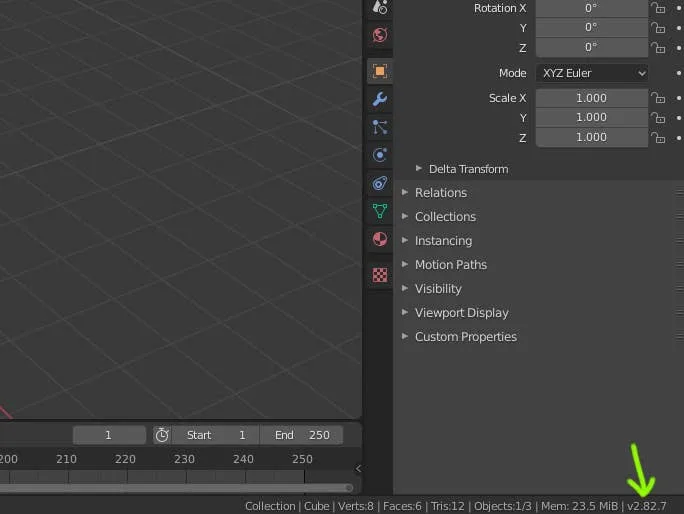
  3. If the splash screen is closed, look in the bottom right-hand corner for the version number. It should appear next to the letter v. For example, v2.82.7.

2 – Manually update Blender

To manually update Blender, you need to both remove and download the newest version from Blender. Here’s how:
  1. Uninstall Blender from your computer.
  2. Download the latest version of Blender from the Blender website.
  3. Run the installer.
  4. Reboot and launch Blender to make sure the version installed is the one you wanted.

3 – Automatically update Blender with Steam

Because Blender is available as a free application in Steam, we can take advantage of Steam’s software updating features to ensure Blender is always up to date. The only drawback is that this method requires the installation of Steam and the creation of a Steam account. Blender is free through Steam. Steam will automatically keep installed games and apps up to date.
  1. Download and launch Steam.
  2. Log into your Steam account.
  3. Download Blender from the Steam Store.
  4. Use Steam to launch Blender.
Steam automatically keeps installed apps up to date unless manually flagged. To adjust update settings for an individual game on Steam do the following:
  1. Go to your software Library and right-click the title.
  2. Choose Properties.
  3. Then click Updates.
  4. Make sure the box is checked to “Always keep this game updated”.
NEXT UP

How to Enable the “Popping” Sound When Adjusting the Volume on Your Mac

howchoo
howchoo (467)
December 13, 2023
Starting with MacOS Sierra and High Sierra, your Mac will no longer play a “pop” sound when you adjust your volume. If you prefer to have this sound when you adjust volume up and down (as I do), this guide will teach you how to reenable it. 1 – Open Sound System Preferences Navigate to System
Continue Reading

howchoo

 467 guides
Introducing Howchoo, an enigmatic author whose unique pen name reflects their boundless curiosity and limitless creativity. Mysterious and multifaceted, Howchoo has emerged as a captivating storyteller, leaving readers mesmerized by the uncharted realms they craft with their words. With an insatiable appetite for knowledge and a love for exploration, Howchoo’s writing transcends conventional genres, blurring the lines between fantasy, science fiction, and the surreal. Their narratives are a kaleidoscope of ideas, weaving together intricate plots, unforgettable characters, and thought-provoking themes that challenge the boundaries of imagination.
Home Interests Guides

How To Watch Google Play Movies on Apple TV

howchoo   (467)
November 23, 2023
4 minutes

Share

Interests
Posted in these interests:
guides • 10 guides

Google Play Movies & TV is a streaming platform that allows users to permanently purchase movies or rent them for a limited amount of time, without a monthly subscription plan. This flexibility makes Google Play Movies & TV a hit, especially for parents looking to entertain their kids for an hour or two.

But how do you watch the movies once they’ve been purchased or rented? If you have Apple TV, there are multiple options.

1 – Stream Your Google Play Movie on your Apple TV via Airplay

  1. Make sure you have the Google Play Movies app downloaded on your iPhone or iPad.
  2. Turn on your Apple TV and go to Settings.
  3. Select ‘AirPlay’
  4. Turn on AirPlay
  5. On your iPhone or iPad, go to your Control Center
  6. Select your Airplay TV from the list of devices
  7. Open Google Play Movies and enjoy!

Please note: Your iPhone/iPad and Apple TV will need to be connected to the same WiFi network for this to work!

2 – Watch Google Play Movies on the YouTube app on Apple TV

While the first method is a good one, this is probably the best (and easiest) way to watch Google Play movies on your Apple TV.

  1. Open the YouTube app on Apple TV
  2. Go to the My Youtube section or click on your profile icon.
  3. Select ‘Purchases and memberships’
  4. There you’ll find a list of purchased Google Play movies that you can stream on your TV!
NEXT UP

How to Change the Windows 11 Start Menu and Button

howchoo   (467)
December 13, 2023

As with every update, Microsoft has changed Windows 11 to look different than its predecessors, and while the update looks modern and clean there are some interesting changes. Arguably the most jarring of all the changes is the one made to the Windows 11 Start Menu, which looks completely different. Instead of a clean, easy-to-navigate

Continue Reading

howchoo

 467 guides

Introducing Howchoo, an enigmatic author whose unique pen name reflects their boundless curiosity and limitless creativity. Mysterious and multifaceted, Howchoo has emerged as a captivating storyteller, leaving readers mesmerized by the uncharted realms they craft with their words. With an insatiable appetite for knowledge and a love for exploration, Howchoo’s writing transcends conventional genres, blurring the lines between fantasy, science fiction, and the surreal. Their narratives are a kaleidoscope of ideas, weaving together intricate plots, unforgettable characters, and thought-provoking themes that challenge the boundaries of imagination.

Home Interests Google Docs

How to Save a Google Doc as a Word Doc (.docx)

Choose “Download.”
howchoo   (467)
November 23, 2023
3 minutes

Share

You’ll Need 1

What you’ll need
Interests
Howchoo is reader-supported. As an Amazon Associate, we may earn a small affiliate commission at no cost to you when you buy through our links.
Posted in these interests:
googledocs • 4 guides
googleworkspace • 6 guides
office365 • 1 guides

If you’re needing to share your Google Doc with someone who is using Word, then you’ll need to convert it. You can’t “save” your new file as a Word document; however, you “download” the Google Doc as a Word file and then save it. In this guide, we’ll show you how to save a Word doc in Google Docs.

Note: It’s a similar process for saving a Google Doc as a PDF.

1 – “Download” as Microsoft Word file

To save a Google Doc as a Word Doc:

  • Go to File.
  • Select Download.
  • Choose Microsoft Word (.docx).

You will be prompted to either open the new Word document or save it to a location on your computer.

2 – Open and save your new Word file

You should be able to open and view your new Word file in Microsoft Word. You’ll still have the original Google Doc saved in Google Docs, as well.

You may need to make some edits in the event that the formatting got messed up. Also, be sure to save your new Word file once you’ve edited it.

Can it be converted back?

Sure! If you need to save a Word document as a Google Doc, then we have a separate guide for that.

How to Save a Word Document as a Google Doc
Convert your Word Doc to a Google Doc…

NEXT UP

How to Search in Google Docs (Find Words)

Try ⌘ + F.
howchoo   (467)
December 13, 2023

If you just need to search and find a single word or multiple words in Google Docs, press ⌘ + F. If you want to find and replace words in your Google Doc, then we’ll show you how to do that too! 1 – Press cmd + F To find a word (or words) in

Continue Reading

howchoo

 467 guides

Introducing Howchoo, an enigmatic author whose unique pen name reflects their boundless curiosity and limitless creativity. Mysterious and multifaceted, Howchoo has emerged as a captivating storyteller, leaving readers mesmerized by the uncharted realms they craft with their words. With an insatiable appetite for knowledge and a love for exploration, Howchoo’s writing transcends conventional genres, blurring the lines between fantasy, science fiction, and the surreal. Their narratives are a kaleidoscope of ideas, weaving together intricate plots, unforgettable characters, and thought-provoking themes that challenge the boundaries of imagination.

<!–
–> <!–

Discuss

–> <!–
–> <!–
–> <!–
–>
Home Interests Python

Class Vs. Instance Variables in Python 3

howchoo
howchoo   (467)
November 22, 2023
14 minutes

Share

<!–
–> <!–

Discuss

–> <!–
–> <!–
–> <!–
–>
Interests
Posted in these interests:
code • 11 guides <!– –>
python • 18 guides <!– –>

When learning object oriented programming in Python, there can be a few gotchas when it comes to distinguishing between class and instance variables. In this guide I’ll explain the difference between class and instance variables and provide examples demonstrating various use cases.

1 – Class vs. instance variables

First, a quick review if you’re new to object-oriented programming. A class is a template for creating objects, and an instance is the object itself. Classes often represent something in the real world, so imagine if you wanted to represent a classroom full of students. You might create a class called Student, which is a template that defines various attributes of a student. Each student, then, is an instance of the Student class.

When dealing with any sort of data, some attributes are going to be unique and some will be shared. Consider our student example, each student in this classroom has the same room number and the same teacher, but they each have a unique name, age, and favorite subject.

Class variables

Class variables are usually variables that are shared by all instances. And they are defined like this:

class Student: teacher = 'Mrs. Jones' # class variable

Each instance of the class will have the same value for these variables:

tom = Student() susan = Student() print(tom.teacher) >> "Mrs. Jones" print(susan.teacher) >> "Mrs. Jones"

Instance variables

Instance variables (also called data attributes) are unique to each instance of the class, and they are defined within a class method, like this:

class Student: teacher = 'Mrs. Jones' # class variable def __init__(self, name): self.name = name # instance variable

See how each instance now contains a unique value for name:

tom = Student('Tom') susan = Student('Susan') print(tom.name) >> "Tom" print(susan.name) >> "Susan"

Summary

This was only a basic overview of class and instance variables. We’ll go into more depth in the upcoming steps, but the most important takeaway is that class variables are typically used for values that are shared among all instances of a class while instance variables are used for values that are unique to each instance.

2 – What to expect from class variables

Class variables are shared among all instances of a class. As a reminder, they are defined like this:

class Student: teacher = 'Mrs. Jones' # class variable

Said another way, class variables reference the same location in memory. See the following:

tom = Student() susan = Student() id(tom.teacher) == id(susan.teacher) >> True

Note: The id function returns the address of the object in memory for the CPython implementation.

So with the id function we can confirm that the teacher attribute refers to the same location in memory.

3 – Modifying a class variable

What happens if we modify a class variable even after we’ve created instances?

tom = Student() tom.teacher >> Mrs. Jones Student.teacher = 'Mr. Smith' tom.teacher >> Mr. Smith

As you might expect, because the teacher variable refers to a shared location in memory, it is updated on the instance as well.

4 – Modifying an instance variable

This is probably the most obvious and expected behavior, so feel free to skip past this step. But I will still show a few examples for completeness.

Consider our Student class with both class and instance variables:

class Student: teacher = 'Mrs. Jones' # class variable def __init__(self, name): self.name = name # instance variable

We can see that each instance of the class has a unique memory address for name:

tom = Student('Tom') susan = Student('Susan') id(tom.name) == id(susan.name) >> False

So as you might expect, updating the name attribute on one instance has no effect on the other:

tom,name >> Tom susan.name >> Susan tom.name = 'Thomas' tom.name >> Thomas susan.name >> Susan

5 – Instance variables override class variables (and methods)

It is important to note that instance variables (or data attributes) override class variables.

Remember the following?

tom = Student() susan = Student() id(tom.teacher) == id(susan.teacher) >> True

What happens if we change the teacher attribute directly on one of the instances:

tom.teacher = 'Mr. Clark'

This is important to note: instance variables need not be declared, they are created whenever they are assigned, and instance variables override class variables. This means, on the tom instance, teacher no longer refers to the class variable, but rather a newly created instance variable.

And naturally, the susan instance is not affected:

tom.teacher # instance variable >> Mr. Clark susan.teacher # class variable >> Mrs. Jones

Hopefully, you see how this behavior can lead to confusion. For this reason, it is important to keep variable names organized. If a variable is declared as a class variable, it should (usually) not be overridden. Instance variables can be defined in obvious places, like the __init__ method. It’s often good to come up with a naming convention for variables. For example, class methods should be verbs, class variables nouns, and instance variables nouns prefixed with an “_”.

6 – Using mutable objects as class variables

Related to the previous step, beware when using mutable objects as class variables. You might be surprised by the behavior.

Imagine we want a list of the student’s test scores. We might compose a class like this:

class Student: teacher = 'Mrs. Jones' test_scores = [] def __init__(self, name): self.name = name def add_score(self, score): self.test_scores.append(score)

We’ve got a class variable to hold the scores, and we’ve got a class method for adding scores. Now let’s add some scores.

tom = Student('Tom') susan = Student('Susan') tom.add_score(90) susan.add_score(100)

Can you guess what mistake we just made?

tom.test_scores >> [90, 100]

Yep, test_scores is a class variable, not an instance variable. Each instance is simply appending values to the class variable. What we really want is for each instance to hold its own list of test_scores.

So a better class might look like this:

class Student: teacher = 'Mrs. Jones' def __init__(self, name): self.name = name self.test_scores = [] def add_score(self, score): self.test_scores.append(score)

And now our problem is solved!

7 – Conclusion

Hopefully you’ve learned the difference between class and instance variables and what to expect from each. If I’m missing something in this guide or if you have any great examples of class and instance variable confusion, please comment below. I’d be happy to add them to this guide!

NEXT UP

Secure Your Sensitive Data with Kubernetes Secrets

Learn how to create and use Kubernetes secrets.
howchoo   (467)
November 26, 2023

Kubernetes secrets are objects that store and manage sensitive data inside your Kubernetes cluster. One mistake developers often make is storing sensitive information like database passwords, API credentials, etc in a settings file in their codebase. This is very bad practice (hopefully for obvious reasons). Most developers know this, but still choose the option because it’s easy.

Continue Reading

howchoo

 467 guides

Introducing Howchoo, an enigmatic author whose unique pen name reflects their boundless curiosity and limitless creativity. Mysterious and multifaceted, Howchoo has emerged as a captivating storyteller, leaving readers mesmerized by the uncharted realms they craft with their words. With an insatiable appetite for knowledge and a love for exploration, Howchoo’s writing transcends conventional genres, blurring the lines between fantasy, science fiction, and the surreal. Their narratives are a kaleidoscope of ideas, weaving together intricate plots, unforgettable characters, and thought-provoking themes that challenge the boundaries of imagination.

Home Interests Linksys

How to Log in to a Linksys Router

howchoo
howchoo   (467)
November 22, 2023
2 minutes

Share

You’ll Need 2

What you’ll need
Interests
Series
Howchoo is reader-supported. As an Amazon Associate, we may earn a small affiliate commission at no cost to you when you buy through our links.
Posted in these interests:
internet • 36 guides
linksys • 2 guides
router • 32 guides

This guide will show you how to log into your Linksys router using the router’s IP address and default login info, allowing you to manage your wireless network.

1 – Connect to your Linksys network

Use your phone, tablet, or computer to connect to your router’s wireless or wired network.

2 – Open a browser and go to 192.168.1.1

The Linksys router login IP is: http://192.168.1.1

Visit that IP address in your web browser to access the login page. If this page prompts you for an email address, select “For local access, click here” first to access the password-only login form.

3 – Enter the Linksys router default login info

Use the Linksys router login password below to log into the router admin:

Linksys router default password

Password: admin

4 – Need help?

If you’re having problems logging into your Linksys router, post in the comments section below and I’ll do my best to help you out!

Average response time: Less than 1 day.

NEXT UP

How to Change Your Frontier WiFi Password

howchoo
howchoo   (467)
November 25, 2023

There are a few reasons you might want to update or reset your WiFi password: making your network more secure, and making your password easier to remember and type. Improved network security You can add an extra layer of security to your network by changing the WiFi password. As long as your new password is

Continue Reading

howchoo

 467 guides

Introducing Howchoo, an enigmatic author whose unique pen name reflects their boundless curiosity and limitless creativity. Mysterious and multifaceted, Howchoo has emerged as a captivating storyteller, leaving readers mesmerized by the uncharted realms they craft with their words. With an insatiable appetite for knowledge and a love for exploration, Howchoo’s writing transcends conventional genres, blurring the lines between fantasy, science fiction, and the surreal. Their narratives are a kaleidoscope of ideas, weaving together intricate plots, unforgettable characters, and thought-provoking themes that challenge the boundaries of imagination.

Home Interests Security

How to Send and Receive Encrypted Messages Using GPG

Another tale of Alice and Bob.
howchoo   (467)
November 22, 2023
12 minutes

Share

Interests
Posted in these interests:
cryptography • 1 guides
security • 6 guides

GPG (GnuPG) is a free and complete implementation of PGP (pretty good privacy). It is a tool used for encrypting, decrypting, and signing messages (or many forms of data). In this guide, we’ll cover the steps to send and receive secure messages using GPG.

For this guide, we’ll assume you want to exchange messages with your good friend, Alice.

1 – Install GPG

First, GPG must be installed.

Ubuntu/Debian

sudo apt-get install gnupg

CentOS

sudo yum install gnupg

MacOS

Using Homebrew.

brew install gnupg

2 – Generate your public and private keys

The first thing we’ll do is generate a pair of keys. To do this run:

gpg --gen-key

You will be guided through the process of generating the key pair. Your keys will be associated with your name and email address.

The private key is protected with a password. Use a strong password, and store that password somewhere secure (password manager and/or physical safe).

Your public key is just that: public. This is the key you can share with anyone.

The private and public keys are generated as a pair, which means they can only be used with their counterpart. The public key, which can be distributed to others, is used to encrypt messages intended for you. So when Alice wants to send you a message, she’ll encrypt the message using your public key. And only the accompanying private key can decrypt that message.

At this point, Alice should follow this step and generate her key pair as well.

3 – Export your public key

Now that you’ve created your key pair, we’ll export the public key.

gpg --export EMAIL > pubkey.asc

The email address you used when you generated your key will be used to export the key as well. This command will generate a file called pubkey.asc. In the future, Alice will import this key and use it to encrypt messages for you.

Alice should follow this step and export her public key as well.

4 – Exchange public keys with Alice

Now you can exchange public keys with Alice.

Note: When sending your key, it’s important that Alice can trust that the key came from you and likewise, that you can trust that the real Alice received your key. This is a security challenge of it’s own and is outside the scope of this guide. Just be sure to use a communication channel that is trustworthy enough.

5 – Import Alice’s public key

Now that you have Alice’s key file, you can import it using:

gpg --import alicepubkey.asc

At this point, you may want to trust Alice’s public key. To do so use:

gpg --edit-key Alice

Then in the gpg prompt, type:

trust

Then select the level of trust 1-5.

6 – Review the keys in your keyring

Let’s list the keys in our keyring to verify that the correct keys exist.

gpg --list-keys

You should see output similar to this:

$ gpg --list-keys

/Users/me/.gnupg/pubring.kbx
-------------------------------
pub   rsa2048 2017-05-03 [SC] [expires: 2019-05-03]
      A43BE404BXE42BF68C3810A329BD7XBDE33C02E9
uid           [ultimate] Tyler <[email protected]>
sub   rsa2048 2017-05-03 [E] [expires: 2019-05-03]

pub   rsa2048 2017-08-01 [SC] [expires: 2019-08-01]
      975B17E6B7A17E4431145375X13E5Y76D6EAEB19
uid           [ultimate] Alice <[email protected]>
sub   rsa2048 2017-08-01 [E] [expires: 2019-08-01]

7 – Encrypt the message you want to send

Assuming your message for Alice is stored in a file called message-for-alice, we can encrypt the message with the following command:

gpg --encrypt --recipient [email protected] message-for-alice

This will encrypt your message using Alice’s public key. The encrypted message will be saved as a new file called message-for-alice.gpg.

Now you can send the encrypted message to Alice.

8 – Decrypt message you’ve received

Upon receiving a message from Alice, you can decrypt the message using your private key.

gpg --decrypt message-for-me.gpg

This will print the message to the console. To write the message to a file use:

gpg --decrypt --output message message-for-me.gpg

9 – Sign a message

Signing a message allows the recipient to verify that the message was not modified during transmission. This is especially important when the message is sent over an insecure channel.

For this example, we’ll sign the message that we encrypted for Alice.

gpg --output message.sig --sign message-for-alice.gpg

This will create a file called message.sig, which is a signed version of the encrypted message.

10 – Verify a signed message

To verify the signed message, use:

gpg --decrypt --output message.gpg message.sig

This assumes that the message was first encrypted, then signed. You should see something like the following output that verifies the digital signature:

gpg: Signature made Tue Nov 21 21:51:45 2017 PST
gpg:                using RSA key A43BE404B2E42BF68C3860A329BD72BDE33C02E9
gpg: Good signature from "Tyler <[email protected]>"

The output file, message.gpg is still encrypted. So you can use the same method to decrypt:

gpg --decrypt --output message message.gpg

11 – GPG Frontends

There are a handful of frontends listed on the gnupg.org site, and I have not tested many of them. But if you’re timid on the command line and would like to find a GUI, there are a few available for each operating system.

NEXT UP

1Password vs NordPass: Who Wins Might Surprise You!

We put the two password managers side by side for you!
howchoo   (467)
September 28, 2023

You might be thinking: 1Password versus NordPass? It’s no contest! 1Password is huge, while NordPass is tiny! Well, it turns out we thought the same thing too. But when we reviewed each in all the major password manager categories, we discovered that it wasn’t the blow-out we would have imagined. We’ve tested each individually We’ve been using 1Password as

Continue Reading

howchoo

 467 guides

Introducing Howchoo, an enigmatic author whose unique pen name reflects their boundless curiosity and limitless creativity. Mysterious and multifaceted, Howchoo has emerged as a captivating storyteller, leaving readers mesmerized by the uncharted realms they craft with their words. With an insatiable appetite for knowledge and a love for exploration, Howchoo’s writing transcends conventional genres, blurring the lines between fantasy, science fiction, and the surreal. Their narratives are a kaleidoscope of ideas, weaving together intricate plots, unforgettable characters, and thought-provoking themes that challenge the boundaries of imagination.

Home Interests Home

How to dig holes in clay

howchoo   (467)
November 22, 2023
2 minutes

Share

You’ll Need 4

What you’ll need
Interests
Shovel x 1
Water x 1
Howchoo is reader-supported. As an Amazon Associate, we may earn a small affiliate commission at no cost to you when you buy through our links.
Posted in these interests:
garden • 1 guides
home • 7 guides
outdoors • 3 guides

Clay can be a real pain to dig in. Whether its footers for a backyard deck or simply potted plants, this is a great way to make it easier.

1 – Mark your hole

2 – Remove the top layer of clay from the marked area

3 – Drill small holes throughout the marked area

Drill as deep as you possibly can.

4 – Fill the hole with water

5 – Wait around 3 hours

This will vary based on the specific soil.

6 – Dig away

If the soil is still hard, add water and more time.

NEXT UP

How to Properly Dispose of a Worn or Damaged American Flag

howchoo   (467)
December 7, 2023

Since our country was conceived, the U.S. Flag has been a symbol of our country’s freedom. Our country’s Flag Code provides specific guidelines for how to “retire” a damaged or worn-out American flag. When should my American flag be retired? The US Flag Code (4 USC Sec 8 Para (k) Amended 7 July 1976) dictates that a flag

Continue Reading

howchoo

 467 guides

Introducing Howchoo, an enigmatic author whose unique pen name reflects their boundless curiosity and limitless creativity. Mysterious and multifaceted, Howchoo has emerged as a captivating storyteller, leaving readers mesmerized by the uncharted realms they craft with their words. With an insatiable appetite for knowledge and a love for exploration, Howchoo’s writing transcends conventional genres, blurring the lines between fantasy, science fiction, and the surreal. Their narratives are a kaleidoscope of ideas, weaving together intricate plots, unforgettable characters, and thought-provoking themes that challenge the boundaries of imagination.

Home Interests Running

How to Clean Vibram Five Finger Toe Shoes Without Ruining Them

howchoo   (467)
November 22, 2023
7 minutes

Share

You’ll Need 5

What you’ll need
Interests
Bucket x 1
Hot water x 1
Howchoo is reader-supported. As an Amazon Associate, we may earn a small affiliate commission at no cost to you when you buy through our links.
Posted in these interests:
fitness • 5 guides
outdoors • 3 guides
running • 2 guides

Vibram Five Finger shoes are awesome pieces of running gear. But you can also use them for hiking and looking weird around town. Unfortunately, toe shoes start to smell if you don’t wear socks with them every time you wear them. While Vibram claims that the shoes are machine washable, you will ruin them if you wash them repeatedly.

Trust us, you don’t want to be wearing these with possible bacteria and/or fungi living inside. That will not bode well for your precious feet. Read on to see the best way to clean your Vibram Five Finger toe shoes.

1 – Place your toe shoes into a bucket

I also threw my gym gloves in there while I was at it. If you’ve never washed your gym gloves before, I would clean them separately from your toe shoes; most gym gloves (even leather ones) will release dye the first time they’re washed. This could taint your pretty toe shoes.

2 – Place a weight on top of the shoes and fill with hot water

Use a weight (I used a ceramic kitchen bowl) to keep the shoes from floating. Fill the bucket with hot water until the shoes and weight are completely covered.

3 – Add denture cleaning tablets

Drop denture cleaning tablets into the water. I used 16 tablets just to be safe — the tablets are really inexpensive and I wanted to be sure that my shoes got really clean.

4 – Let your shoes soak overnight

Place the bucket somewhere out of the way and let it sit overnight.

🛈 Denture cleaners are minty and smell nice — keep the bucket away from pets. Though the tablets aren’t toxic to humans, your dog may not have a great time after drinking a bunch of dirty denture tablet water.

5 – Rinse your shoes

Remove your shoes from the bucket and run them under a faucet. This will thoroughly remove any denture cleaning residue that might exist.

6 – Dry your shoes

This part is extremely important. If you do not dry the shoes properly, they will begin to smell right away. There are a few methods for doing this: – Hang them in front of a powerful fan for a few hours (this is what I did). – Hang them outside in an area where a nice breeze exists. – Air-tumble dry them in your dryer on the delicate setting; be sure not to use a large amount of heat as this may shrink the material. – Place them on the floor directly in front of your refrigerator; this method is only effective for certain types of refrigerators that push air and heat out beneath the front doors.

7 – Keeping them clean moving forward

The best way to keep your toe shoes clean moving forward is to always wear toe socks with them. Toe socks aren’t terribly expensive and really pay off in the long run.

NEXT UP

How to dig holes in clay

howchoo   (467)
November 22, 2023

Clay can be a real pain to dig in. Whether its footers for a backyard deck or simply potted plants, this is a great way to make it easier. 1 – Mark your hole 2 – Remove the top layer of clay from the marked area 3 – Drill small holes throughout the marked area

Continue Reading

howchoo

 467 guides

Introducing Howchoo, an enigmatic author whose unique pen name reflects their boundless curiosity and limitless creativity. Mysterious and multifaceted, Howchoo has emerged as a captivating storyteller, leaving readers mesmerized by the uncharted realms they craft with their words. With an insatiable appetite for knowledge and a love for exploration, Howchoo’s writing transcends conventional genres, blurring the lines between fantasy, science fiction, and the surreal. Their narratives are a kaleidoscope of ideas, weaving together intricate plots, unforgettable characters, and thought-provoking themes that challenge the boundaries of imagination.